
 |
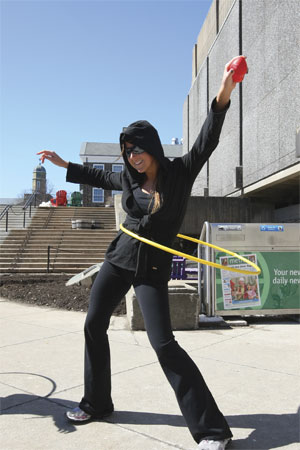
| Fourth-year recreational management student Katie Ozolins stops for a little hula hoop. (Nick Pearce Photo) |
A group of onlookers gather at a picture window in the Henry Hicks building early Monday morning looking down at students jumping rope on the sidewalk. The students are laughing and having fun in spite of the cold and their giggles come out in great white plumes.
“What the heck’s going on?†we wonder, staring down at the students. But it’s not recess—it’s a carefully orchestrated play break involving students in the Recreation Management program.
Fourth-year student Robert Craig and six of his classmates are involved in organizing and implementing what he calls Random Acts of Play. Over the past term, the students staged fun leisure activities around campus; they encouraged other students to join in if they saw them jumping rope, playing hopscotch and hula hoop or tossing a ball.
“Random Acts of Play is a student-run initiative to help elevate Dal to its next level of greatness by engaging students in just a few moments of meaningful play,†says Mr. Craig, who got the idea while attending a recreation conference in the U.S.
“We want to change the way students and faculty perceive play and challenge them to begin incorporating play into their everyday life,†he continues.
His professor is all for it.
“It’s OK to stop and have fun, it’s OK to stop and jump rope, it’s OK to play hopscotch or to toss a ball, just because,†says Barbara Hamilton-Hinch, assistant professor of leisure studies, in the School of Health and Human Performance. Play is important to help wake up body and mind and re-energize.
For a recent study, researchers placed a large red ball in an open area outside; they watched as young kids came up and touched the ball, bounced off the ball, or kicked it around – while adults simply walked around it.
“It’s easy to see that a little bit of leisure recreation can change your whole day,†says Prof. Hamilton-Hinch. “But sometimes, as people get older, we think playing is just for children.â€